
Overview
Molybdenum-100, or Mo-100, is a stable isotope of molybdenum and one of the most strategically significant isotopes in modern nuclear medicine. While molybdenum is naturally composed of seven stable isotopes, Mo-100 stands apart due to its unique role as the primary precursor for the production of Technetium-99m (Tc-99m) – the most widely used radioisotope in diagnostic nuclear medicine worldwide.
Supplied in its enriched oxide form (¹⁰⁰MoO₃), Mo-100 is the essential starting material for a global medical imaging supply chain that serves hundreds of millions of patients annually.
Key Properties of Molybdenum-100 Oxide
| Property | Value |
|---|---|
| Isotope symbol | ¹⁰⁰Mo |
| Atomic number | 42 |
| Neutrons | 58 |
| Atomic mass | 99.907 Da |
| Natural abundance | ~9.82% |
| Stability | Stable (non-radioactive) |
| Common supply form | Enriched oxide (¹⁰⁰MoO₃) |
| Typical enrichment level | ≥99% |
In its natural state, molybdenum contains only ~9.82% Mo-100. For medical and research applications, isotopic enrichment is required to produce material with Mo-100 content of 99% or above – eliminating interference from other molybdenum isotopes in downstream processes.
The Mo-100 → Tc-99m Production Pipeline
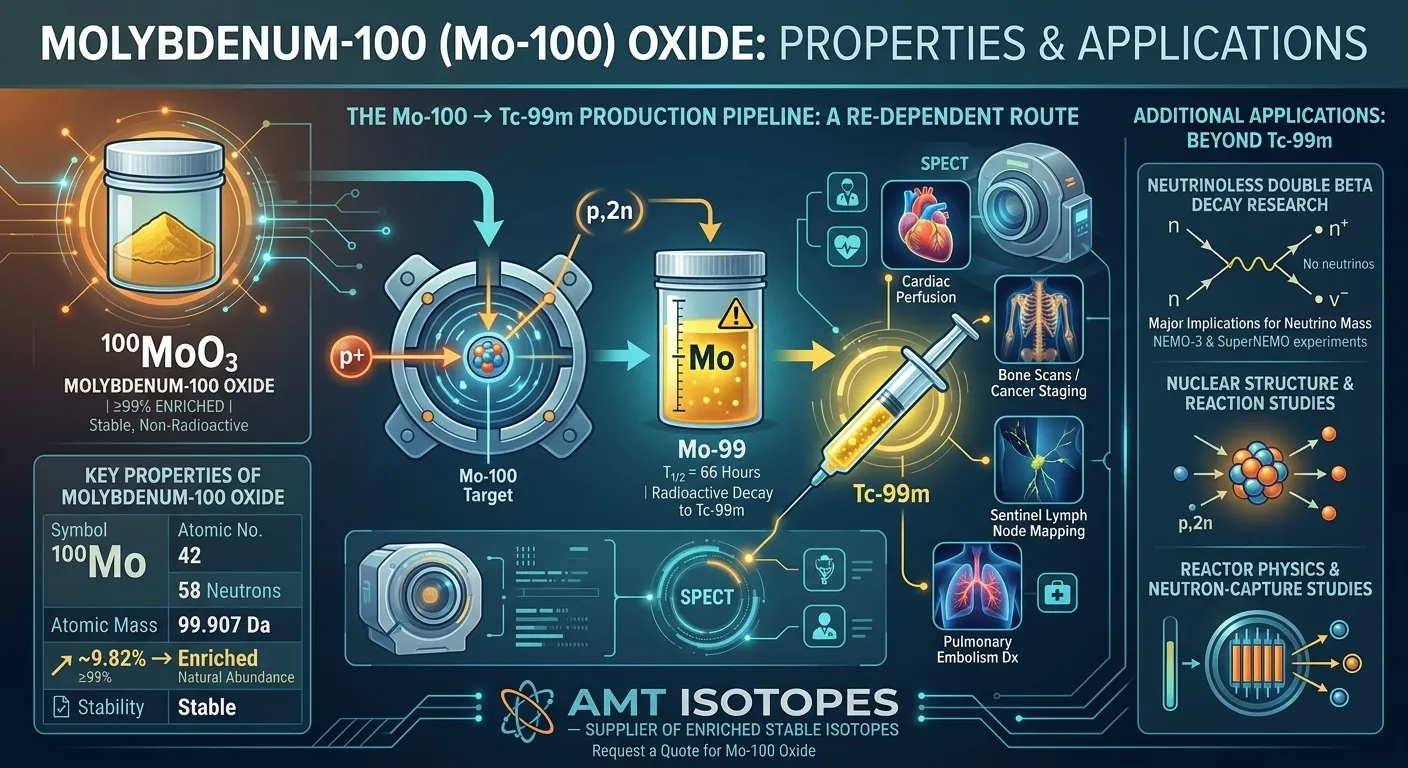
The single most important application of Mo-100 is the production of Molybdenum-99 (Mo-99), which decays to yield Technetium-99m (Tc-99m).
Tc-99m is used in an estimated 40–50 million diagnostic procedures every year, making it by far the most commonly used radioisotope in nuclear medicine. It is the active agent in SPECT imaging for:
- Cardiac perfusion imaging
- Bone scans for cancer staging and fracture detection
- Sentinel lymph node mapping
- Renal and thyroid function studies
- Pulmonary embolism diagnosis
The production route begins with enriched ¹⁰⁰MoO₃ as a target material. When irradiated in a particle accelerator (cyclotron), Mo-100 undergoes a (p,2n) nuclear reaction to produce Mo-99, which then decays with a 66-hour half-life to Tc-99m. This cyclotron-based approach offers a reactor-independent route to Tc-99m production – a significant advantage for supply chain resilience, as illustrated during historic nuclear reactor shutdowns that disrupted global Tc-99m supply.
This same “enriched stable isotope as target → radioisotope output” pipeline is also the foundation of other key nuclear medicine pathways, such as the production of Lutetium-177 from Ytterbium-176 (Yb-176) and the production of Scandium-44 from Calcium-44 (Ca-44).
Additional Applications of Mo-100
Beyond the Tc-99m supply chain, Mo-100 has several other established and emerging uses:
Neutrinoless double beta decay research. Mo-100 is one of a small number of isotopes considered promising candidates for experiments searching for neutrinoless double beta decay – a hypothetical nuclear process whose detection would have major implications for particle physics and our understanding of neutrino mass. Experiments such as NEMO-3 and SuperNEMO have used enriched Mo-100 as a detector material.
Nuclear structure research. Mo-100’s neutron-rich character makes it a useful target isotope in nuclear structure and reaction studies carried out at research accelerators worldwide.
Reactor applications. Like other molybdenum isotopes, Mo-100 has relevance in reactor physics, particularly in neutron-capture cross-section studies and materials irradiation research.
Why Enrichment Level Matters for Mo-100 Applications
For cyclotron-based Tc-99m production, the enrichment level of the Mo-100 oxide target directly determines both the yield and the purity of the resulting radiopharmaceutical product. Lower Mo-100 enrichment means more contamination from other molybdenum isotopes, which can reduce Tc-99m yield and introduce unwanted isotopic impurities into the final clinical product.
This is why nuclear medicine producers, research centers, and accelerator facilities sourcing Mo-100 consistently specify high-enrichment material (≥99% Mo-100) with full isotopic certificates – the same standard applied to isotopes such as Iron-57 (Fe-57), Ytterbium-176, and Helium-3 (He-3) supplied for comparable high-precision applications.
Sourcing Molybdenum-100 Oxide from AMT
AMT Isotopes supplies enriched Molybdenum-100 oxide (¹⁰⁰MoO₃) for cyclotron-based radioisotope production, nuclear physics research, and related applications. Every batch is accompanied by a full certificate of analysis and certificate of origin, with reliable international delivery to research institutions, hospitals, and pharmaceutical manufacturers.
Request a quote for Mo-100 Oxide or explore our full isotope catalog for available forms and quantities.